


IC TECHNOLOGY GIVES MORE TIME TO LIVE AND LOVE

Updated: Sep 8
TECHNOLOGY DESIGNED TO UNCHAIN, NOT CHAIN

There are ideas that seem to belong to another time until, suddenly, they become remarkably relevant to the present.
Recently, we came across a reflection by Antonio Gala, one of the most celebrated Spanish writers, playwrights, and intellectuals of contemporary Hispanic literature. Asked what he considered the most intelligent thing one could do in life, Gala did not speak about knowledge, productivity, money, technology, or professional success. Instead, he spoke about escaping the labyrinth in which we sometimes allow ourselves to become trapped: leaving behind a life that is no longer really our own, breaking free from the chains created by an organization that turns people into its servants, and recovering the ability to give each day not only its responsibilities, but also its own smile, its own enjoyment, its own color and its own aroma.
And then came the sentence that stayed with us:
“Because an intelligence that does not help us live, I don't want it. It is of no use to me.”
We could not stop thinking about it. Decades before artificial intelligence, SaaS platforms, digital transformation, automation, and supply-chain optimization became part of our everyday vocabulary, Gala had already identified a fundamental question: What good is intelligence if it does not make life better?
Perhaps that is exactly the question technology should be asking today.
The Modern Labyrinth
We live surrounded by technology designed to make things easier. We have more information than any generation before us, software for almost every conceivable task, artificial intelligence, cloud platforms, automated workflows, digital marketplaces, instant communication, analytics, dashboards, CRMs and an endless collection of applications promising to improve productivity.
And yet many professionals seem to be working longer hours than ever.
They answer messages at night, move from meeting to meeting, coordinate suppliers, distributors, contractors, manufacturers, consultants, and customers, search for technical information, verify specifications, compare alternatives, correct misunderstandings, and follow up with people who were supposed to follow up with someone else.
Eventually, the technology designed to simplify their lives becomes another layer they have to manage on their own.
That is the paradox of modern efficiency.
We have become extremely good at making people work faster. Perhaps we have not become nearly as good at making them work less. This is particularly visible in complex industries such as energy, where a single project may involve manufacturers, distributors, engineers, designers, system integrators, installers, contractors, consultants and end users, sometimes spread across different countries and operating according to very different commercial and technical priorities.
Every participant may have a legitimate role. The problem is what happens between those roles.
Information gets lost. Specifications change. Responsibilities become unclear. Commercial interests influence technical decisions. Margins accumulate without necessarily creating proportional value. And people spend enormous amounts of time coordinating activities that, ideally, should have been integrated from the beginning.
The result is a labyrinth.
And sometimes, without realizing it, the people operating the labyrinth become prisoners of it.
Technology Can Automate a Process — But Can It Remove the Friction?
This distinction is at the heart of the Integration Coefficient IC. Digitalizing a process does not automatically make that process efficient. Automating a bad process does not make it a good one. And adding another software platform to an already complicated supply chain can sometimes create a more sophisticated labyrinth instead of an exit from it.
The question we began asking was different: What if technology were designed not merely to accelerate processes, but to reduce the friction between the people, companies, and technologies involved in those processes?
That question led us to the Integration Coefficient IC.
What Is the Integration Coefficient IC?
The Integration Coefficient IC is a business and technology framework developed by Jaime Ventura Energy Consultant to identify and reduce friction between manufacturers, solution providers, integrators, and end users, particularly in energy projects.
The basic idea is simple. A technically excellent component does not automatically create an excellent solution. The value of an energy solution depends not only on the quality of its individual components, but also on how effectively those components, the people involved, and the user's actual requirements are integrated.
This is where the IC model looks at something that conventional approaches often overlook: the space between the participants. An energy solution can involve an excellent manufacturer, a capable engineer, a qualified installer, and a legitimate end user, yet still produce an inefficient result if the information, expectations, responsibilities, and commercial interests connecting them are poorly integrated.
The objective of the IC model is therefore not simply to remove people from the process. It is to identify and eliminate unnecessary friction.
And that distinction matters.
The goal is not to eliminate expertise. It is to make expertise more accessible.
The goal is not to eliminate manufacturers, integrators, or installers. It is to connect them more effectively.
The goal is not to replace human judgment with software. It is to use technology so that human judgment can be applied where it creates the greatest value.
The Hidden Cost Nobody Includes in the Proposal
When we evaluate an energy solution, we normally look at CAPEX, OPEX, ROI, payback period, equipment cost, and projected energy savings. All of these are important.
But there are other costs, and they rarely appear in a proposal.
Costs of searching, waiting, coordinating, correcting, explaining, duplicating, comparing, following up, troubleshooting, and managing unnecessary intermediaries.
There is also another resource being consumed throughout the process: human time. And unlike equipment, human time cannot be purchased back.
This leads us to a question that we believe deserves to become part of the definition of efficiency:
How much time does a solution return to the people who use it?
That may sound philosophical, but it is actually an operational question.
If a system saves money but requires hundreds of additional hours of coordination, is it truly efficient?
If software automates ten tasks but creates fifteen new administrative tasks, has it really simplified the business?
If an entrepreneur cannot leave the phone for a weekend because the entire operation depends on his or her personal intervention, is that business actually optimized? Or has it simply become dependent?
The IC Ecosystem: IC-CHAT, IC-APP and IC Ambassadors
These questions eventually led us to something larger than an individual application. We began developing an ecosystem in which technology and human expertise perform different but complementary functions.
The three principal elements are IC-CHAT, IC-APP, and IC Ambassadors. They are not three unrelated concepts. They are three layers of the same integration philosophy.
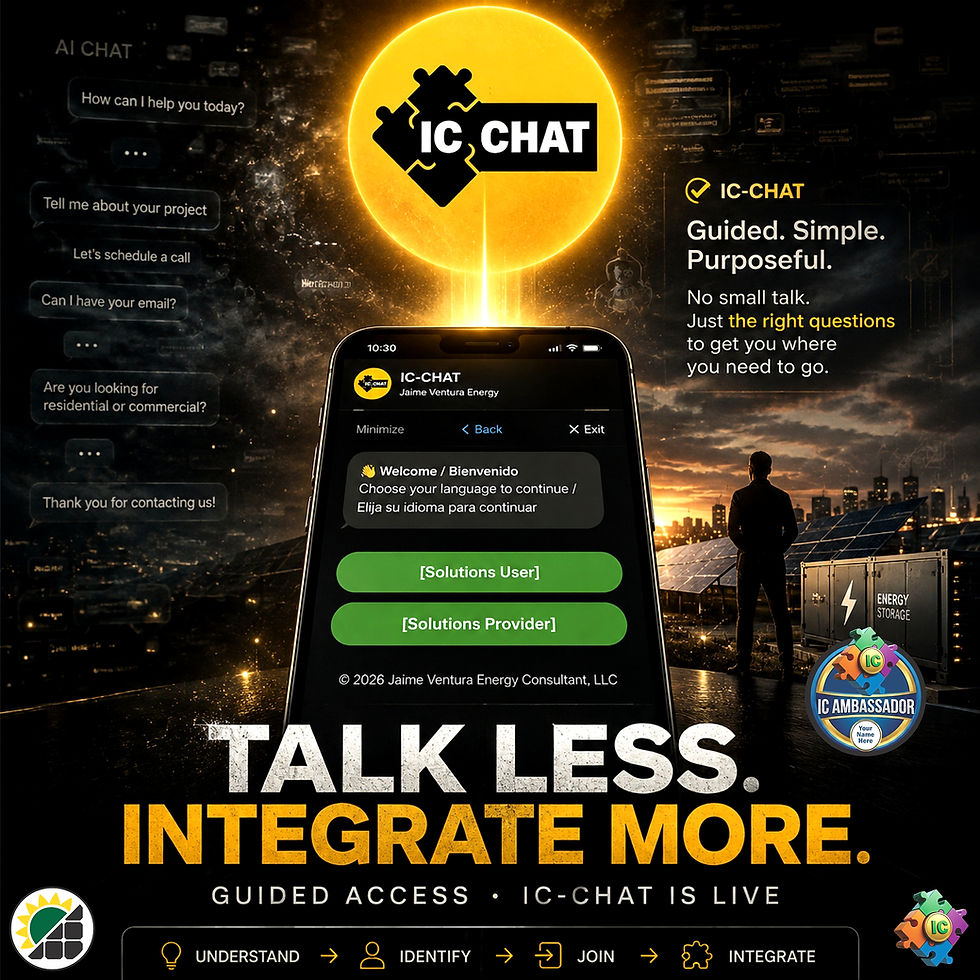
IC-CHAT: From Questions to Understanding
The first problem many users face is not necessarily a lack of technical information. It is that they usually do not know exactly what they need. A business may know that it has a power quality problem. A facility may know that it needs backup protection. A company may want to explore solar generation. A Telecom operator may need a different power architecture.
But identifying the right solution is not always obvious to the person experiencing the problem.
IC-CHAT is designed as the first transition layer.
SEO-GEO / Discovery → WEB → IC-CHAT
Its purpose is to help users move from a general need or question toward a more structured understanding of what they may actually be looking for. It is not intended to replace engineers or specialists. Quite the opposite. It is intended to make the interaction with specialists more productive by helping the user reach the right conversation sooner.
IC-APP: From Understanding to Action
There is another way for a customer need to be identified: the next challenge is turning that understanding into participation. That is where IC-APP enters the architecture.
The IC-APP is designed to structure the user's request, identify the corresponding solution path, and facilitate the transition from an initial need toward an actionable request. Instead of forcing users to navigate through multiple disconnected sources, the objective is to create a more integrated path:
SEO-GEO / Discovery → IC-APP / Participate → WEB.
Then, there is no single starting point in the IC ecosystem. A user may discover IC-APP through search, promotion, or sharing and begin there, while another may arrive directly at the website through search and encounter IC-CHAT. Both provide a similar fundamental function: helping users move from a general need or question toward a clearer path to an energy solution. The difference is in how they engage the user. IC-APP adds interaction through sharing and feedback, while IC-CHAT works directly within the website experience.
In that sense, they work less like successive steps and more like the two blades of an old-fashioned double-blade razor: what the first one misses, the second one catches. And, in the IC ecosystem, either one can lead the user back into the broader system.
Both tools are therefore more than digital forms. They are part of the operational architecture of the IC model. And, importantly, the IC-APP itself is being developed according to the same principle it promotes: it must integrate with its users. That is why the Founding Users Program exists.
The Founding Users Program: Technology Has to Integrate With People
A piece of software can work perfectly from a programming perspective and still fail from a user's perspective. Buttons can function. Forms can submit. Data can be transmitted. Pages can load. And the user can still think: “What am I supposed to do now?”
That is why the Founding Users Program (FUP) is more than a conventional beta test. It is an integration experiment. Users are helping us identify where the process is intuitive, where it creates friction, what information is missing, what expectations are not being met, and what should happen next.
In other words, we are applying the Integration Coefficient IC to the development of the IC's own technology. That may sound circular, but it is actually the point.
IC Ambassadors: Technology Still Needs Humans
There is a temptation in the age of artificial intelligence to believe that everything should eventually become automated. We disagree. Energy is a deeply technical industry, but it is also a deeply human one. Complex projects require judgment, experience, trust, interpretation, and, sometimes, someone who can simply say:
“I understand what you are trying to accomplish. Let me help you find the right path.”
That is where the IC Ambassador becomes essential. IC Ambassadors represent the human connection layer of the IC ecosystem. They help promote the IC model, identify opportunities, connect users with appropriate expertise, and provide human follow-up and guidance throughout the process. Technology can organize information. It can filter. It can identify patterns. But people still build relationships. And when the project matters, that relationship matters.
The Goal Is Not More Productivity
This may be the most important distinction. The goal of the IC model is not to create a world where everyone can accomplish twice as much work in the same amount of time. That simply gives us twice as much work.
The objective is different: to reduce the amount of unnecessary work.
Reduce friction, duplication, searching, waiting, and unnecessary coordination. Reduce dependence on individual people and reduce the amount of human intervention required simply to keep a process moving. When those things are reduced, something becomes available again.
Time.
Time Should Be an Efficiency KPI
Perhaps we have spent too many decades measuring efficiency only in financial and operational terms. What if we added another KPI? We call it: Time Returned to People.
Imagine evaluating a business process by asking how many hours of human coordination it requires, how many unnecessary interactions it creates, how much duplicated work exists, how dependent the process is on one individual, and how much time technology can genuinely return to the people involved.
This does not replace traditional financial metrics. It complements them.
Because a business model that generates economic value while consuming enormous quantities of human life has achieved only partial efficiency. And perhaps this is where the original idea of intelligence becomes relevant again.
And Then There Is Life
Antonio Gala spoke about escaping the labyrinth, breaking the chains, and giving each day not only its responsibilities, but also its own smile, its own enjoyment, its own color, and its own aroma. That is not a rejection of work. It is not laziness. It is not an argument against ambition. It is an argument for remembering why efficiency exists in the first place.
We work to live.
We build companies to create value. We develop technology to solve problems. We optimize processes so that resources are used better. But if all that optimization eventually leaves us with less time to experience the life we were supposedly improving, something has gone wrong.
A Rather Unscientific Experiment in Ensenada
And this is where the story becomes personal. While the Founding Users Program continues to evolve and the IC ecosystem continues to take shape when combined with the IC-CHAT and the IC-APP, some of the operational architecture is increasingly capable of functioning without requiring everyone's constant physical attention.
IC-CHAT can handle initial interactions. IC-APP can structure requests. IC Ambassadors can provide human follow-up. And the people building the system can occasionally step away.
In our particular case, that created a rather unscientific experiment.
The Project Leader could spend time in Ensenada and the Valle de Guadalupe, enjoy Mexico, walk peacefully in the seaport and, most importantly, spend some lovely time with his wife.
And remarkably… The business did not collapse. But maybe they did. 😂 Not from stress, fortunately.
They collapsed into life.
Perhaps that is not a conventional technology benchmark. But maybe it should be.
Again, IC Technology Gives More Time to Live and Love
This is ultimately where the IC philosophy takes us. Not toward technology for technology's sake. Not toward automation for automation's sake. Not toward another software platform that promises to make us “more productive.”
Toward something much simpler.
More time to live.
And, perhaps even more importantly:
More time to live and love.
Because the purpose of eliminating friction is not merely to fit more work into our calendars. It is to create enough space in our lives for the things that cannot be measured in spreadsheets: a conversation, a walk, a trip, a glass of wine, a laugh, a sunset, a kiss, or a day in Ensenada with the person you love.
Those are not inefficiencies. They are the reason efficiency matters.
Technology Designed to Unchain, Not Chain
The world does not necessarily need more complicated systems. It needs better integrated ones. The energy industry does not necessarily need more intermediaries. It needs better connections between the right participants. Users do not need to become experts in every technology they purchase. They need better ways to reach the people who can help them. And professionals should not have to sacrifice their entire lives simply because the systems they built became dependent on them.
This is the philosophy behind the Integration Coefficient IC.
It is the philosophy behind IC-CHAT, IC-APP, and the IC Ambassador.
Together, they represent an attempt to build an ecosystem where technology, business processes, and human expertise work together rather than creating additional layers of friction.
We design technology to unleash processes, not to chain people.
Because perhaps the ultimate measure of intelligence is not how much more we can accomplish. Perhaps it is how much more life we can have while accomplishing what really matters. And that brings us back to Gala. An intelligence that does not help us live is not enough.
We want something better. More time to live and love.
Does your system liberate the path — or has it simply built a more sophisticated labyrinth?
We hope you like how we did it to relate such different concepts: IC TECHNOLOGY GIVES MORE TIME TO LIVE AND LOVE.
Please get back to us with your comments.


Comments