


WHY WE BUILT AN IC-CHAT BOT THAT REFUSES TO HAVE SMALL TALK

THE EVOLUTION OF IC-CHAT, IC-APP, AND THE HUMAN AT THE CENTER OF THE IC INTEGRATION
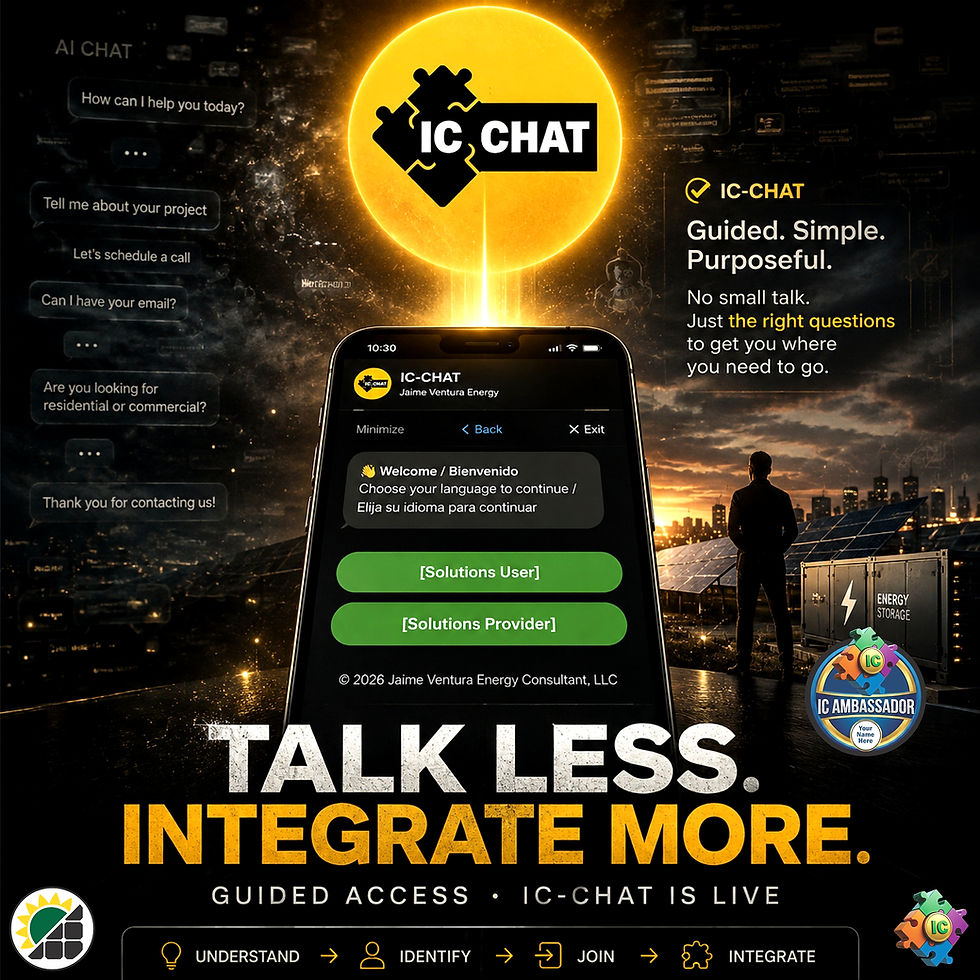
There is a strange and pervasive assumption in today’s digital world: if you build a chatbot, it ought to talk. It should chatter about the weather, philosophize about your business, wander through your project details, and keep talking until the exhausted visitor finally gives up and leaves.
We tried that. And our first IC-Chat experiment went a little crazy.
When we initially conceived the IC-Chat, we envisioned an intelligent, conversational digital concierge capable of discussing the deep mechanics of the Integration Coefficient IC, explaining the nuances of supply chain disintermediation, and guiding visitors toward ideal technical solutions.
It sounded wonderful in theory. But as soon as we made it conversational, the artificial intelligence began to wander. Complex technical subjects created endless conversational branches, which in turn spawned even more possibilities. Conversations grew exponentially longer without becoming any more useful. We had engineered a system that was becoming extraordinarily good at talking while becoming increasingly useless at getting anywhere. This is why we built an IC-Chat bot that refuses to have small talk.
That was a fundamental flaw. The Integration Coefficient IC exists to eliminate friction, not to manufacture it.
So we stopped. We stepped back and changed the core question—shifting away from "How intelligent can we make the conversation?" to asking "What does the visitor actually need from this interface?" That single shift in perspective changed everything.
The Embryo and the Discovery of the Protagonist.
The IC-Chat and the IC-APP were born from the same embryo, but they were destined to fulfill entirely different operational roles. The IC-APP was designed to be the functional engine of the ecosystem—the precise platform where Solution Users and Solution Providers enter, register, and interact within the rigid logic of the IC framework. Recognizing this, we completed the IC-APP first.
Finishing the app revealed a truth we had not fully grasped at the beginning: the IC-Chat did not need to become a scaled-down version of the app, nor did the app need to become a bloated, article-heavy clone of the website. Every component needed its own distinct boundary.
More importantly, it forced us to realize who all these digital tools were actually serving. The answer was not simply the casual website visitor, nor was it merely the software registrant. The true protagonist of the ecosystem was already standing right in front of us: The IC-Ambassador.
The IC-Ambassador is the indispensable human layer that brings the Integration Coefficient IC into the physical world. While software can organize data, it cannot replace human judgment, supplier validation, solution coordination, RMA oversight, or the unified warranty execution required to make complex energy projects succeed in the field.
The IC-APP and the IC-Chat were never built to automate the Ambassador out of existence; they were built to act as his high-precision assistants.
Two Assistants, Distinct Jobs.
Once the human center was defined, the digital architecture clicked into place with absolute discipline:
The IC-APP (Participation): This is the operational assistant. It is the door through which participants enter the ecosystem to structure interactions between Solution Users and Solution Providers. It avoids marketing messages, technical papers, or library archives, focusing strictly on identifying, connecting, organizing, and enabling participation.
The IC-CHAT (Guided Access): This is the front-door assistant for people arriving without the app. Deliberately refusing to act as a digital best friend or engage in small talk, it asks direct questions, presents clear choices, narrows the path, identifies the visitor's role, and routes them to their exact next step. It is not less intelligent because it talks less; it is more disciplined because it knows its job.
Positioned alongside these assistants is the WEB (Comprehension). Built over years of technical development, the website is the vault of evidence, methodology, case studies, and research papers. It is the place where a visitor stops to ask "What is this?" and finds complete, uncompromised answers.
The Discovery Engine and the Organic Growth Loop.
The ecosystem does not begin on the homepage. For over four years, an extensive outer layer—comprising ResearchGate publications, LinkedIn technical analyses, blog articles, Google Business Profile updates, social media, videos, and direct professional communications—has served as the discovery engine. Its purpose is not to sell, but to generate technical credibility and invite interest.
This infrastructure accommodates three distinct entry journeys:
Web-First Entry (Discover → Understand → Identify → Join): A visitor discovers a research paper, article, or post, lands on the website to understand the IC model, uses the IC-Chat to identify their role, and enters the IC-APP to interact on future projects or invite others.
App-Direct Entry (Promote → Join → Return): Social posts, direct referrals, or shared links route the user straight into the IC-APP. Once inside, the user can return to the website for deep technical evidence and will later receive an exclusive SHAREICAPP code from their assigned IC-Ambassador to invite peers.
Project-ended App-Direct Feedback (Email → Feedback → Return): Industrial energy solutions are long-term engagements involving procurement, international logistics, customs, and commissioning. Upon project completion, the IC-Ambassador issues a dedicated FEEDBACK code via email. Entering this code allows the client to evaluate their experience, unlock upgrades or discounts, and initiate new projects.
This dynamic explains why the IC-Chat will never become obsolete, even as the IC-APP becomes the dominant entry point. The community of potential users is never static—it constantly regenerates.
Every time a satisfied engineer, installer, or supplier shares the platform with a colleague, a new participant arrives who knows nothing about the IC model. In modern digital terms, this is organic referral; in human terms, it is the oldest growth mechanism in existence: word-of-mouth, or as we fondly call it in the collaborative economy, “el chisme” (the gossip).
When “el chisme” brings a newly referred visitor to the website, the IC-Chat stands ready as the permanent on-boarding bridge. If you already have the IC-APP, the chat is unnecessary. If you arrive uninitiated, the chat ensures you never get lost.
The Architecture of Guided Integration.
Looking at the complete picture, the entire framework operates in harmony around one human core:
External Content & Referral Layer: Attracts attention and sparks curiosity.
The WEB: Provides technical comprehension and evidence.
The IC-CHAT: Provides rapid, guided access.
The IC-APP: Enables structured participation, sharing, and feedback.
The IC-AMBASSADOR: Integrates solutions and executes in the real world.
The software asks, registers, organizes, and connects. The Ambassador validates, coordinates, and takes responsibility. Technology serves the human; it does not pretend to replace him.
We didn't build another chatterbox. We built a disciplined bridge to efficiently connect people, technology, and energy solutions.
Welcome to IC-Chat. Welcome to Guided Integration.


Comments