


OUR IC AMBASSADORS ARE THE MISSING LINK IN ENERGY SOLUTIONS

WHY COMPLEX PROJECTS NEED AN IC-AMBASSADOR, NOT ANOTHER BOX SELLER

We want to talk today about going from fragmented supply chains to integrated solutions — and from digital tools to the human layer that makes integration happen.
The Problem Starts Long Before the System Fails
For decades, the energy infrastructure business has become remarkably good at selling components—and remarkably inefficient at moving complete solutions through the supply chain.
An inverter from one manufacturer. Batteries from another. Protection equipment from a third. Installation, logistics, and commissioning handled somewhere else. Each component and service may be perfectly good on its own. The problem is the economic journey between the factory and the final project.
Every additional intermediary adds a margin. Every fragmented purchase reduces purchasing leverage. Every local stock requirement ties up capital. Every additional border, tariff classification, and customs process introduces another layer of uncertainty. And in markets already dealing with high tariffs, inflation, volatile import conditions, and regulatory or political pressure around energy technologies, those layers do not simply add administrative friction.
They compound the final cost of the solution.
A component that leaves a factory at a competitive price can arrive at the project carrying the accumulated cost of distributors, local markups, fragmented logistics, inventory financing, customs complexity, and duplicated commercial structures.
The result is a paradox:
The technology becomes cheaper and more efficient, while the supply chain surrounding it keeps making the final solution more expensive. And when the system finally reaches the customer, there is another problem.
The inverter belongs to one company. The batteries belong to another. The protection system to someone else.
Everything has a seller. Everything has an invoice. And when something goes wrong, everyone may have a warranty—but nobody necessarily owns the integration.
The installer gets trapped in the middle. The customer carries the operational risk.
The Integration Coefficient IC attacks the problem upstream.
Instead of treating supply-chain inefficiency as an unavoidable cost of doing business, the Integration Coefficient IC model looks at the solution as a whole: how components are selected, integrated, sourced, consolidated, classified, transported, and ultimately delivered to the project.
Where appropriate, multiple components can be engineered and integrated at origin into a single solution package, while purchasing volume, logistics and the specific customs environment of each territory can be considered as part of the solution design.
The objective is simple: not merely to find cheaper components, but to reduce the friction and accumulated cost between the factory and the customer. And that is where the IC-Ambassador becomes important.
This is not necessarily a technology problem. It is an integration problem.
And that problem is where the story of the IC-Ambassador begins.
The Market Was Screaming
The first IC-Ambassador was not created as a job description. He emerged from the problem.
After approximately three to four decades working inside the energy and power-quality supply chain, our first Project Leader had spent enough time watching the same pattern repeat itself: fragmented suppliers, multiple intermediaries, disconnected warranties, inefficient logistics, and customers trying to make sense of a system assembled from pieces that were never designed to behave as one.
The market was effectively screaming for something different. The answer was not another distributor. It was not another product catalog. It was integration.
The first IC-Ambassador recognized the problem because he had lived inside it. And from that experience came the first IC solution—an approach designed not around selling another box, but around integrating the components, suppliers, logistics, and responsibilities required to deliver a complete solution.
That first solution eventually became something much larger.
This Solution Became a Model: The Integration Coefficient IC
The original idea did not arrive as a perfectly designed business architecture sitting on someone's desk. It evolved. The same philosophy that produced the first solution began revealing other areas where fragmentation was creating unnecessary friction. One solution became several. Several became eleven strategic solution categories.
And as the number of solutions grew, another question naturally appeared:
Who would bring this model into the market? The answer was the IC-Ambassador.
Not a conventional salesperson. Not a box mover. Not someone expected to become an engineer, customs broker, project manager, and product specialist overnight.
The IC-Ambassador is the strategic human connector between the IC ecosystem and the real-world market. His or her role is to identify the client's actual need, connect it to the appropriate IC solution, and facilitate the integration process. When the requirement falls outside the established solution framework, the Project Leader and technical team take over.
The Ambassador does not need to know everything. The Ambassador needs to know what needs to happen next—and who needs to make it happen. That distinction turned out to be extremely important.
The IC-Ambassador Is Not Here to Replace Your Business
There is another misconception worth eliminating. An IC-Ambassador is not someone who abandons an existing business to become an IC salesperson. Quite the opposite. The model was designed around professionals who already have a business, clients, technical or commercial experience, market relationships, and a reputation in their territory.
The IC proposition is simple: Don't start over. Expand what you already have.
The IC Business Model is designed to simultaneously expand the Ambassador's economic environment and improve the business already being managed. It provides access to new types of integrated energy projects, new customers, international suppliers, and digital tools, while allowing the Ambassador to continue building on the market position already established.
That is why the IC-Ambassador is fundamentally different from a traditional sales representative. The objective is not simply to sell more equipment. The objective is to create more economic possibilities around an existing business.
From Selling Components to Integrating Solutions
Traditional supply chains tend to separate responsibility. One company sells the inverter. Another sells the batteries. Another sells protection equipment. Another handles installation. Another handles logistics. And when something goes wrong, the famous ping-pong of responsibility begins.
IC approaches the problem from the opposite direction. Instead of asking: Which component do you want to buy? The process begins with: What problem are we trying to solve? The IC-Ambassador then helps identify the appropriate solution category and brings the request into the IC integration process.
The model may involve pre-engineered and pre-tested kits or packages, coordinated suppliers, factory-origin integration, unified guarantee structures, and consolidated purchasing strategies where appropriate. The purpose is not to add another intermediary to the chain. It is to remove unnecessary friction from the chain.
The Ambassador therefore becomes something very different from a hardware salesperson.
The Ambassador sells—or more accurately, facilitates—engineering, logistics, integration, and peace of mind.
Then We Tried to Build an AI Ambassador
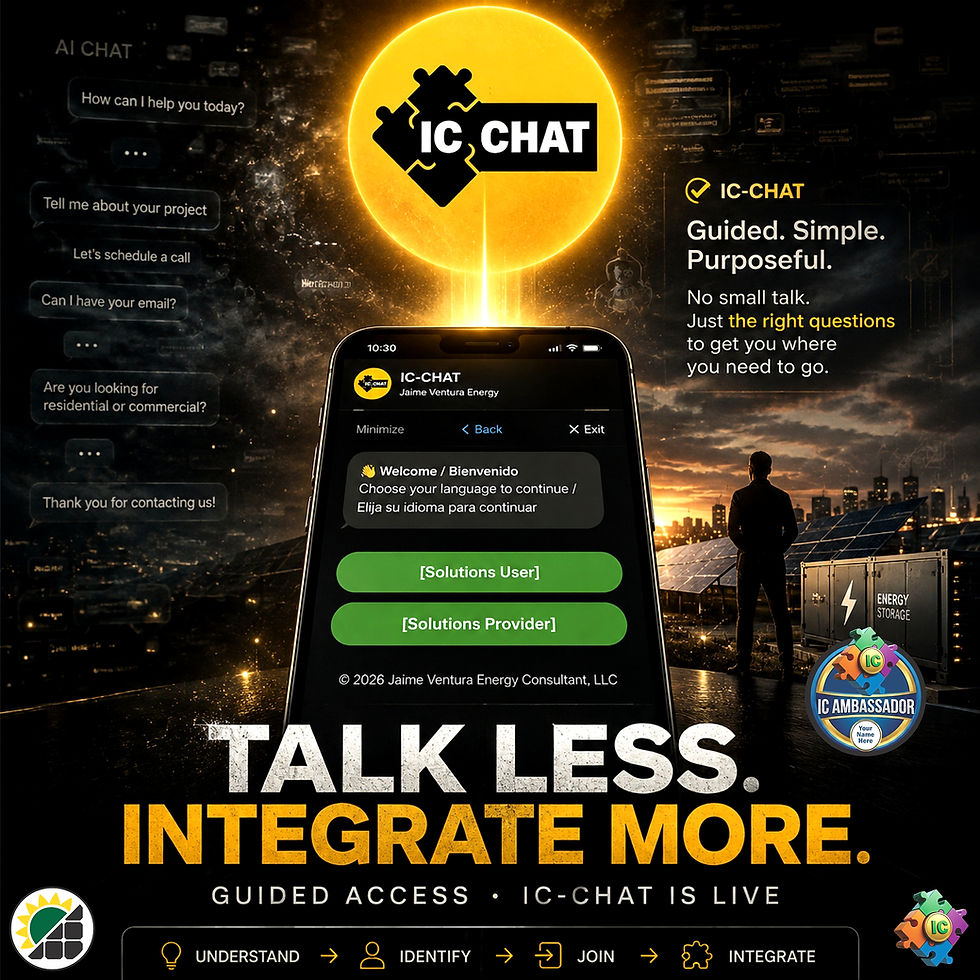
And this is where the story took an unexpected turn. As IC evolved, it became obvious that the human Ambassador would need digital tools. So we began developing a smart (almost human) IC-Chat.
At first, the ambition was rather innocent: Why not build an intelligent digital Ambassador? We trained the system with more and more information. The eleven solutions, user profiles, Supplier qualification, Warranty and RMA processes, Savings, Commercial arguments, Lead capture, Closing, Escalation, Technical documentation, Objections, Language, Tone, the philosophy of IC.
The more we added, the more complicated the system became. And eventually, the Chat (and in parallel the IC-APP) started becoming exactly what we were trying to avoid: too much conversation, too many branches, too much information, and too many opportunities to wander away from the actual purpose.
The experiment failed. But the failure was useful. Because we realized we had been asking the wrong question. We thought we were building an AI Ambassador. We eventually realized we were building digital assistants for the IC-Ambassador.
That distinction changed the architecture.
The Digital Layer Was Never Meant to Replace the Human Layer
The solution became specialization.
The WEB explains the model and provides the knowledge environment.
IC-Chat identifies, guides, and registers.
IC-APP enables participation, connection, sharing, and feedback.
And the IC-Ambassador does what software is not designed to do: integrate people, companies, decisions, and real-world projects.
The digital tools reduce friction for the IC-Ambassador. They do not eliminate the IC-Ambassador. In fact, the opposite happened. The more we understood what the IC-Ambassador actually does, the more obvious it became that the digital architecture should be built around the human role, rather than trying to turn the human role into software.
The IC-Ambassador is where the digital ecosystem meets the physical economy.
The IC Communication Loop
This is also why IC should not be understood as a traditional marketing funnel. It is better understood as a circular communication and participation ecosystem:
DISCOVERY → IC-APP →WEB → IC-CHAT → IC-AMBASSADOR → FEEDBACK → SHARING → DISCOVERY
The entry point can vary. A search may lead someone to the website, and the visitor uses the IC-CHAT. SEO tools may lead visitors directly to the IC-APP. A referral may lead directly to the website or to the IC-APP. A shared IC-APP invitation may introduce a new user to the ecosystem. Someone may encounter IC through ResearchGate, LinkedIn, Mailchimp, a YouTube video, an IC-Ambassador, or another user. The important point is what happens afterward.
The ecosystem learns. The user provides feedback. The Ambassador generates new relationships. Users and suppliers share the model. And those interactions create new opportunities for discovery. And multiply the network and experiences.
The loop continues. This is why the IC-APP and IC-Chat are not independent technology projects. They are digital components of an ecosystem whose ultimate purpose is integration. The broader architecture already distinguishes the roles clearly: WEB for comprehension, IC-Chat for guided access, IC-APP for participation, and the IC-Ambassador for real-world integration.
So, What Exactly Is an IC-Ambassador?
An IC-Ambassador is an experienced energy professional who incorporates the Integration Coefficient IC Business Model into an existing business to expand and improve it.
Our next IC-Ambassador already has something valuable: local knowledge, clients, relationships, experience, reputation, market credibility.
The IC adds another layer: international suppliers, integrated solutions, a broader economic network, and digital tools designed to make the business more efficient and scalable.
The Ambassador's role is to identify needs, connect them with the appropriate IC solution, and facilitate integration. That means the IC-Ambassador does not need to become a walking encyclopedia of every technology inside the IC ecosystem. The IC-Ambassador needs to recognize the problem, ask the right questions, capture the essential information, and know when to involve the Project Leader and technical team.
That's the job. And that is precisely why the role can be replicated.
We Are Looking for a Few People, Not Everybody
This is not a mass recruitment campaign. It is not even a recruitment process. It is an Invitation to sustainability and supply chain improvement.
We are looking for experienced energy professionals in selected markets across the United States, Latin America (including the South Cone), the Caribbean, Spain, Italy, India, and other international territories.
If you already operate an installation, engineering, consulting, or energy-related business, we are not asking you to abandon it. We are asking a different question:
What could your business become if its economic environment were larger?
The IC model is designed to help an existing business access new types of integrated projects, new clients, and international suppliers while improving the efficiency and competitiveness of the business already in place. You do not start from zero. You bring what you already know. IC brings the integration framework, solutions, network, and digital infrastructure.
The objective is not to create another sales force. It is to create a network of independent professionals capable of bringing IC integration into their own markets.
Could You Be an IC-Ambassador?
We are interested in professionals who already have: an established presence in the energy sector; technical or commercial experience; relationships with customers or installers; knowledge of their local market; the ability to identify real customer needs; and an entrepreneurial mindset. Again, you don't have to know everything. You do have to understand that selling a component and solving a problem are not the same thing.
If that distinction makes sense to you, there may be something worth discussing.
And again, this is an invitation—not a mass recruitment campaign. If you believe your profile fits the model, tell us about your business, your market, and the type of customers you serve. We will determine together whether there is a fit.
The first conversation can be as simple as a virtual coffee via Google Meet, or please contact us by:
WhatsApp: +1 747-400-9687
The IC-Ambassador Was There Before the Technology
The irony of this entire evolution is that the technology did not create the IC-Ambassador. The problem did.
The market created the need. Experience identified the opportunity. The first Ambassador developed the first solution: the IC philosophy. The solution became a model. The model created more solutions. The solutions created the need for more IC-Ambassadors. And eventually, the Ambassadors needed digital assistants.
So we built them. Not to replace the human layer. Just to make integration easier. IC was not designed all at once. It evolved by listening to the problems of a market that needed integration.
And perhaps that is the most important thing we have learned along the way:
The future of complex energy solutions may not belong to the company that sells the most boxes. It may belong to the people who know how to integrate the boxes, the suppliers, the technology, the logistics—and the people behind them.
That is what an IC-Ambassador does. OUR IC AMBASSADORS ARE THE MISSING LINK IN ENERGY SOLUTIONS.


Comments