


THE INTEGRATION COEFFICIENT IC AS AN ELECTROTECHNICAL ALIGNMENT TOOL

Updated: May 11
WHEN THE UPS DOES NOT KNOW THE BATTERY IT IS CHARGING

Most UPS systems are built on a tacit assumption: VRLA is the default battery chemistry, and everything else is an exception.
That is why almost no UPS manufacturer’s application engineer is trained to answer a question like this: “Can I connect a nickel-cadmium (NiCd) battery bank to your standard three-phase UPS?”
The usual answer is a “NO” based on firmware limitations. However, the electrochemical barrier they describe does not actually exist; what actually exists is a parametric mismatch.
In those cases, we use the Integration Coefficient IC as an electrotechnical alignment tool. IC is more than a mathematical formula; it is a methodology for achieving that alignment. In environments where administrative stasis — the so-called SAP trap — forces engineers to operate under inherited procurement codes, IC becomes a practical framework for legacy upgrades.
The Integration Coefficient IC goes far beyond a simple supply-chain concept. The IC-based approach evaluates how precisely the UPS DC bus, battery chemistry, float voltage, discharge limits, and rectifier topology fit together. The tighter the alignment, the more stable the system behaves over its full service life.
When backup duration increases, when industrial environments become harsher, or when reliability expectations demand more than short autonomy windows, the battery stops being a passive component and becomes the defining element of system behavior. At that point, the question is no longer whether UPS can charge a battery, but whether it is charging the right battery, in the right way.
Although UPS manufacturers are often reluctant to support NiCd batteries — because modern chargers are designed around VRLA assumptions — IC allows us to synchronize the NiCd battery’s discharge “knee” with the UPS low-voltage disconnect (LVD) threshold. By adjusting the chemical variable — specifically, the number of cells and the float voltage per cell — we can make a basic charger perform with an industrial-grade level of equalization.
This article presents two disruptive but complementary metrics: ICcharge and ICdischarge.
ICcharge evaluates whether the UPS float voltage per cell matches the battery’s electrochemical requirements.
ICdischarge verifies whether the UPS low-voltage disconnect aligns with the battery’s natural end-of-discharge behavior.
When both metrics approach unity, the battery operates inside its intended window. When they diverge, long-term reliability begins to deteriorate. See Figure 1 — ICcharge versus cell count.
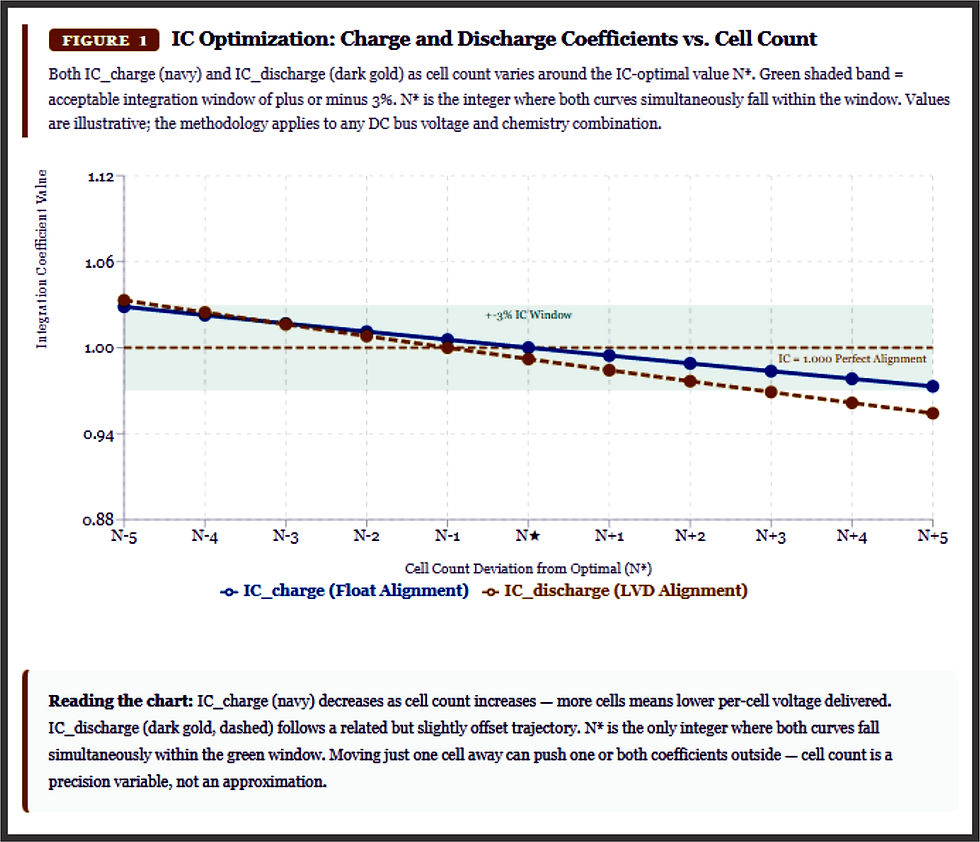
This relationship reveals something simple but powerful: integration is often achieved not by changing hardware, but by selecting the correct number of cells. The interface between systems becomes the optimization variable.
This becomes especially important when NiCd batteries are used for multi-hour backup. NiCd chemistry behaves differently from VRLA in ways that directly affect UPS performance. For KM-type NiCd only — not KL (usually, the “static” SAP does not mention the type)— the discharge curve remains almost flat for most of the cycle, internal resistance is lower, and the system tolerates deep discharge without the progressive voltage collapse typical of lead-acid technologies. In long-duration backup applications, these differences are not marginal; they redefine inverter loading, thermal behavior, and usable capacity. See Figure 2 — Discharge Curve Comparison: NiCd KM vs. VRLA at Equivalent Capacity.

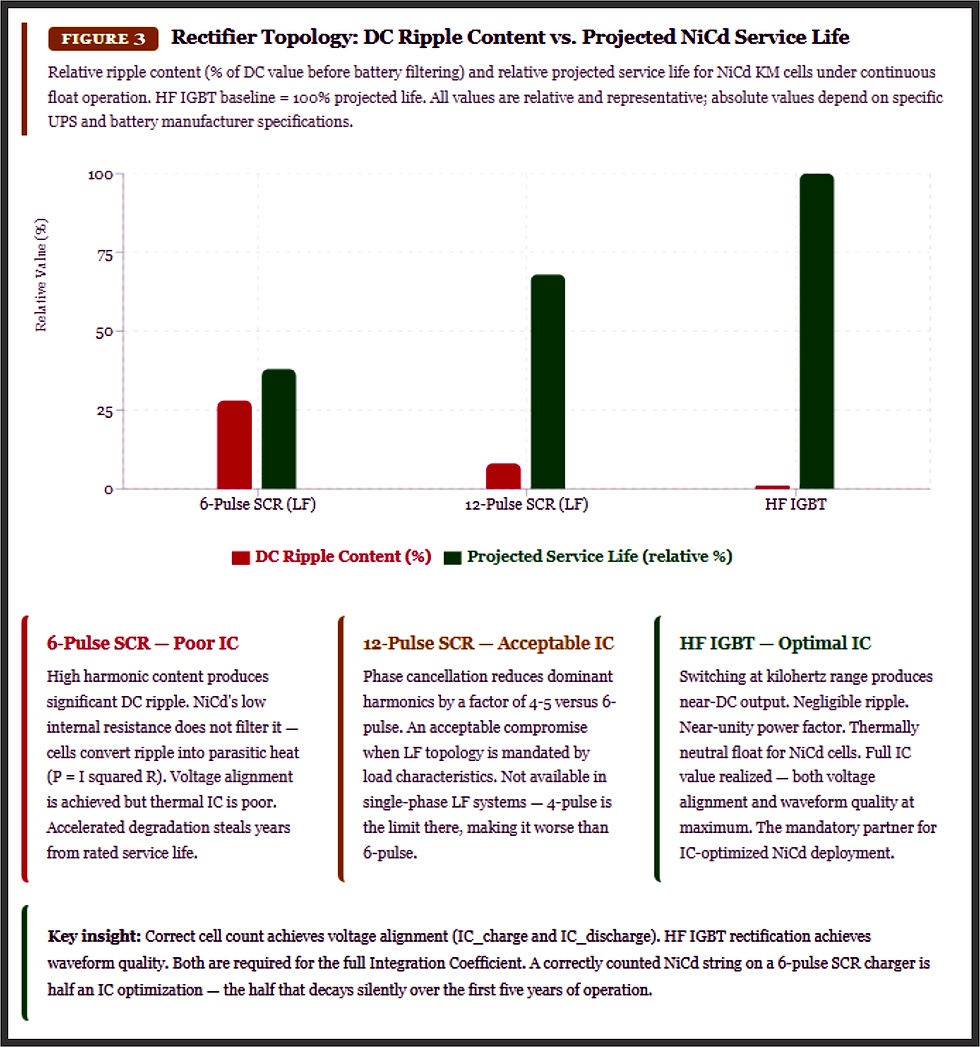
However, voltage alignment alone is not enough. The UPS rectifier section also becomes a critical factor. A 6-pulse rectifier (SCR or IGBT) introduces ripple that flooded NiCd cells do not naturally filter. Over time, that ripple becomes heat, and that heat becomes accelerated aging. A 12-pulse configuration — whether SCR or IGBT, with IGBT performing much better because it produces far less ripple — creates a much more acceptable charging environment. But high-frequency rectifiers with PF = 1 are the best solution, provided that the AC load protected by the high-frequency UPS is not a high inrush load, in which case low-frequency inverters are preferable (and again, the SAP does not mention any of these external factors).
So this is not only about volts and amps; it is about Infrastructure Sovereignty.
The ripple effect: Standard 6-pulse rectifiers (SCR or IGBT) are battery killers because of their high RMS ripple. And worst when UPS is single phase with 4-pulse rectifiers.
The SAP fossil: Procurement systems are often still stuck in the 1990s, insisting on NiCd in cases where OPzS or OPzV would be more resilient — or vice versa — based on outdated stakeholder pressure rather than field reality. See Figure 3 — Ripple impact by rectifier topology. This comparison shows why waveform quality matters as much as average voltage.
Once these variables are viewed together, the misconception disappears. A UPS is not just a converter; it is a battery environment. And if that environment is misaligned, even the most robust chemistry will underperform.
Conceptual case study: LATAM and the “fundamentalist” SAP
In this real-world case, involving an oil company in Latin America, SAP is treated almost like a religion. If the system code specifies a “NiCd battery” for use with single-phase and three-phase low-frequency UPS units, the purchaser will buy NiCd — even if the grid is a disaster, with more than one interruption cycle per day, making the battery destined to fail within two or three years due to the stress of constant charge-discharge cycling. Worse, that failure rate is accelerated further by ripple current from a 6-pulse rectifier (and 4-pulse in single-phase UPS units); a component chosen almost always because it lowers the UPS unit price and because the SAP system says nothing about the technical incompatibility.
The real TCO of SAP
When selling a NiCd battery bank, the supplier invoices a price three to four times higher than an OPzS or OPzV battery bank (the latter being suitable only for temperature-controlled environments). However, if a 6-pulse rectifier is purchased, and cycling is excessive (daily), the system may fail in about three years. Therefore, the true 20-year total cost of ownership required up to six separate NiCd replacements, resulting in an extraordinary overall cost: up to 15 times higher than an OPzS bank, which would have lasted three times longer thanks to its superior cycle capability and greater tolerance to the high ripple voltage produced by cheaper UPS rectification systems.
The Engineering “Insurrection” and the “Dignified Exit”
IC proposed a technically sound and dignified solution:
Option A (Administrative Sovereignty): Modify the SAP code to specify OPzS or OPzV tubular batteries — if the site temperature is controlled, which the supposedly “unchangeable” SAP also fails to specify — for use in unstable grid environments and with more cost-effective UPS units. These batteries are significantly cheaper, extremely robust, built “like tanks” in terms of cycling capability, and they do not require the mystique or specialized handling associated with NiCd.
Option B (the “Ethical Exit”): If the SAP parameters are immutable, use an “IC-optimized” NiCd configuration that incorporates a specific technical “trick”: an exact cell count calibrated so that each cell voltage stays near the “semi-equalization” threshold. Combined with 12-pulse rectification — and even better, IGBT — this ensures clean DC input and allows the battery system to reach its full 20-year service life, provided that cycling is not too frequent. Even so, the IC-optimization will remain lower compared with a rationally selected OPzS system, because of the constant cycling, but this is the only way for NiCd to survive longer despite that.
CONCLUSION: Engineering Sovereignty and the Resilience Guide
The Integration Coefficient IC is not a textbook formula; it is a tool for engineering insurgency: a way to recover technical control from stagnant SAP codes. This work shows that systemic flexibility can be measured conceptually and used to guide critical decision-making. The engineer operating in hostile environments is not merely an installer, but a guerrilla-level adapter.
Our mission with this article is to hit buyers where it matters most: in the wallet. Our goal is to move beyond simple voltage debates and instead address profit loss and total cost of ownership.
We want to show that blindly following SAP codes is economic sabotage and that IC represents the optimal use of the customer’s assets.
The Integration Coefficient IC reframes the problem. Instead of asking whether a UPS supports a given battery chemistry, the question becomes whether the whole system is aligned with that chemistry. That shift turns compatibility into engineering.
In long-duration industrial backup scenarios, that alignment is often the difference between theoretical autonomy and real autonomy; between nominal battery life and effective battery life; between acceptable operation and optimized operation.
The UPS may think it knows what battery it is charging. The IC approach verifies whether it actually does.
If your UPS specification assumes battery chemistry is a secondary issue, this IC-based framework may change that assumption.
Are you a specification follower or a system optimizer? Stop managing mediocrity and start mastering your assets.
Stay tuned. This is just the beginning of a weekly "Trilogy UPS" articles series where we’ll dive into SAP stasis and then show how the Integration Coefficient IC cuts through the entire structure: load type, UPS topology, chemistry, ambient temperature, maintenance capacity, grid instability, carbon footprint, and even the question of whether the facility should remain dependent on the grid at all.


Comments